How do you cover it?
I’d recommend starting with this video, which shows how to cover a 1V geodesic dome:
2:45: they’re adding timber to reduce the gaps in the covering
3:45: they’re starting to unfold the covering tarpaulin. First, they staple it to the uprights, pulling it tight. The staples are only there to hold it taut; it will later be secured with lintels. They start with the walls.
5:20: they add the lintels by nailing them to the uprights (you can also use screws)
2V dome with a tarpaulin
You can start the next video at 3:13
Note:
- It covers the entire dome without any cut-outs
- It uses wooden battens to hold the tarpaulin in place
- At around 4:50, he explains how to deal with the creases
- He starts at the top: he pulls the tarpaulin tight and finishes at the bottom.
Example of covering a Domestar 2V dome with timber
Credit: Henrik S.
Covering a 3V dome
This page clearly explains how to cover a 3, 5/8-frequency dome using just 5 pieces (but this also applies to 3, 3/8-frequency domes)
What materials do you need?
As for the materials, it will depend on what you want to achieve: whether you want to turn your geodesic dome into a chicken coop, a greenhouse, a workshop or a garden shed.
If you want to turn it into a greenhouse, then UV protection is essential. Simply search for ‘greenhouse cover’. Here are some options:
https://www.baches-direct.com/fr/pm/baches-serre-largeur-3m
Made from 150-micron LDPE (low-density polyethylene)
https://www.serre-en-direct.fr/bache-pour-serre/68-bache-pour-serre-sur-mesure-polyane-pro-200.html
Made from 200-micron polyethylene, costing less than €2 per m² with a 5-year guarantee.
https://www.jardincouvert.com/films-baches-filets/baches-films-serre/
Which offers either ‘thermal’ or ‘diffusive’ tarpaulins.
You can avoid a lot of cutting by realising that for the base, one roll is enough: as you wrap it round, the sheet will adjust itself without the need for any cuts.
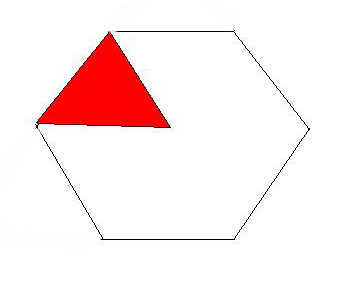
For the top, you need a hexagon from which you’ve simply cut out a triangle: